
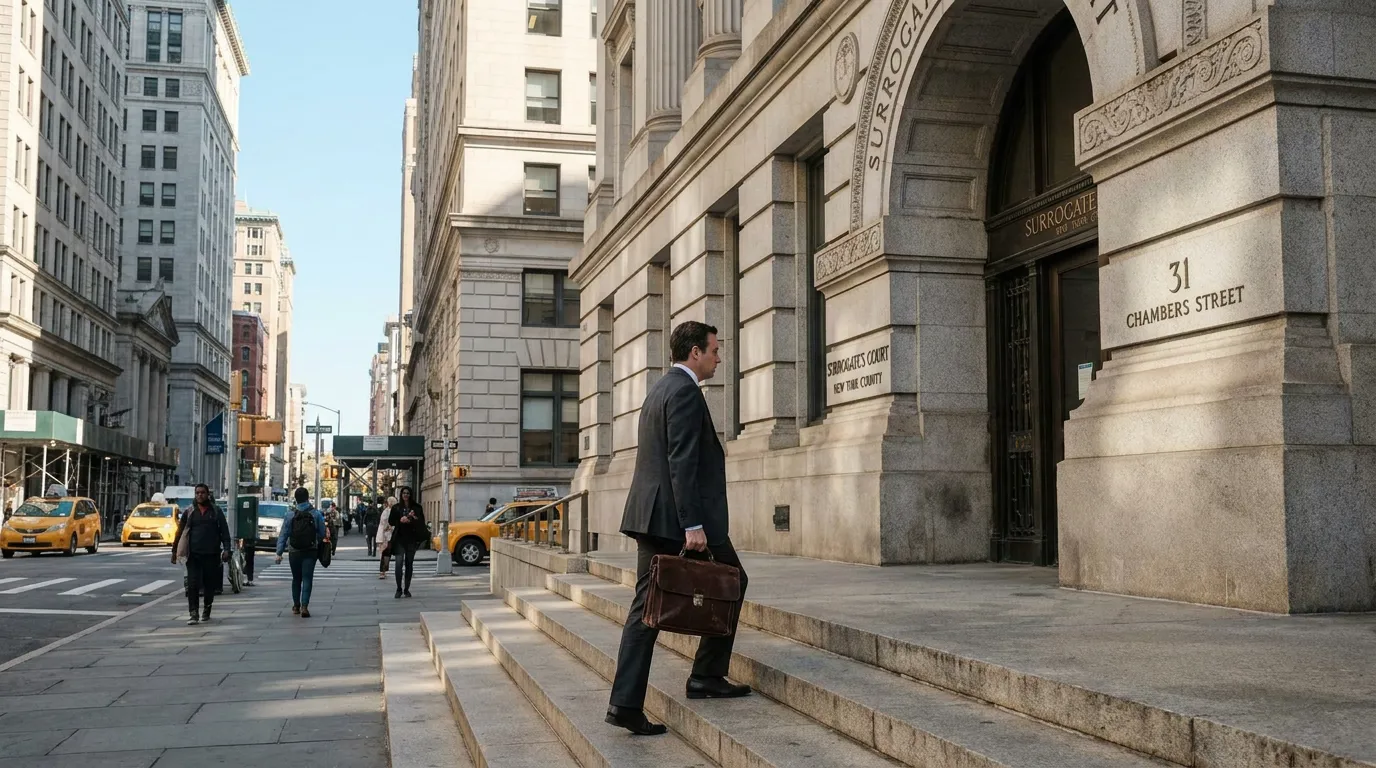
When an Out-of-State Estate Owns Property in Western New York
Key Takeaways: Ancillary probate is a supplemental New York Surrogate’s Court proceeding governed by Article 16 of the SCPA that allows a fiduciary to take authority over New York assets when the decedent was domiciled elsewhere. It is most often triggered by real property, as a New York deed generally requires authority recognized by a New York court. The Commissioner of Taxation and Finance must be named as a party in a nondomiciliary’s estate. Because New York imposes its own estate tax on nonresidents’ real and tangible personal property located in New York, filers commonly submit three Forms ET-20 (Stipulation Reserving Domicile) and Form ET-141 to preserve the position that the decedent was domiciled elsewhere. Many matters begin with Form AU-67 requesting a Waiver of Citation and Consent, which typically takes approximately four weeks.
When someone dies domiciled in another state but leaves behind real estate or other property in New York, the home-state probate alone generally cannot transfer that New York asset. A second proceeding is usually required in the county where the property sits. That proceeding is ancillary probate, which allows a New York Surrogate’s Court to recognize the foreign will or out-of-state administration and issue ancillary letters giving a fiduciary authority over New York situs assets. For families in the Buffalo, Niagara region, this often arises with Florida and Arizona retirees who kept a home in Amherst, Hamburg, or Lewiston, and with Canadian owners of Western New York property.
If your family is facing this situation, early guidance matters because several required steps run on their own timelines. The attorneys at Roach, Lennon & Brown, PLLC regularly guide domiciliary executors and out-of-state families through New York Surrogate’s Court administration. Call 716-235-3025 or contact us now to discuss how the process would apply to your circumstances.
Understanding Ancillary Probate in New York for a Nonresident Decedent
Ancillary probate New York nonresident decedent proceedings are supplemental, not duplicative. The domiciliary jurisdiction remains the primary forum; New York’s role is limited to assets located here. Under Article 16 of the Surrogate’s Court Procedure Act, the Surrogate’s Court in the county where the decedent had assets reviews the home-state proceeding, may admit the will to ancillary probate where requirements are met, and may appoint an ancillary fiduciary.
Practically, the trigger is usually real property. Bank accounts and brokerage assets can sometimes be handled by the domiciliary executor without a New York filing, though financial institutions may still require New York letters. Real estate is different because a New York deed generally requires authority recognized by a New York court. Erie and Niagara County families frequently discover this need only when a buyer’s title company raises the issue at closing.
The Tax Department Is a Named Party by Statute
New York law affirmatively brings the state’s tax authority into the case. Under NY Tax Law § 971-a(a), every petition for ancillary letters in the estate of a decedent not domiciled in New York must set forth the Commissioner of Taxation and Finance as a party to be cited. The statutory scheme governing estates of nonresident decedents also provides that the decree awarding letters may contain provisions for payment of tax or security.
There is cross-border coordination as well. NY Tax Law § 971-a(b) requires the Commissioner to notify the taxing authorities of the decedent’s domicile state of the petition filing and to furnish information about the decedent’s property and value. The Commissioner must cooperate with those authorities; for these purposes, "state" includes Canada and its provinces.
Why Domicile Is the Issue That Deserves the Most Attention
Filing in New York should not concede that the decedent was a New Yorker. New York imposes a state estate tax with its own exemption threshold. For a nonresident decedent, the New York estate tax generally reaches only real and tangible personal property located in New York, while a domicile determination would expose the entire estate. Because of this risk, ancillary filers are commonly asked to submit three Forms ET-20, "Stipulation Reserving Domicile," with original signatures, along with Form ET-141, the New York State Estate Tax Domicile Affidavit.
These forms are protective in nature. They preserve the position that the decedent was domiciled elsewhere while allowing the New York proceeding to move forward; they do not resolve the domicile question. Where domicile is genuinely close, a snowbird who kept a Buffalo homestead, for example, the analysis is fact-sensitive and courts and taxing authorities may weigh many indicators. Have counsel evaluate it before filing.
The Waiver of Citation and Consent, and Why Timing Matters
Many ancillary cases begin with a request to the Tax Department for a waiver. According to the state’s estate tax forms and guidance, a Waiver of Citation and Consent allows a Surrogate’s Court proceeding to continue without issuance of a citation to the Tax Department. Requesting it through Form AU-67 is a standard early step; if no waiver is obtained, the Department must be cited to complete jurisdiction.
Build the timeline around it. The Tax Department’s instructions state that turnaround time for a waiver is approximately four weeks, meaning a family hoping to close on a sale in thirty days may be disappointed. Counsel generally assemble and submit the waiver package before the ancillary petition is finalized.
💡 Pro Tip: Requesting a release of lien to transfer a decedent’s New York real property is a separate process using Form ET-117, and those requests should not be sent to the Waiver of Citation and Consent Unit. Confusing the two is a common source of delay.
What New York Typically Asks You to Assemble
For ancillary probate or administration of a nonresident decedent, the state identifies a specific document package. Knowing it up front helps Buffalo-area families gather materials once:
- A copy of the death certificate and the decedent’s Social Security number
- A copy of the will, if any
- A copy of the probate or administration petition from the original state or country
- A copy of the proposed ancillary petition
- Three Forms ET-20 (Stipulation Reserving Domicile) with original signatures
- Form ET-141 (New York State Estate Tax Domicile Affidavit)
Requirements can vary, and the Surrogate’s Court will separately require its own filings, including authenticated copies of the domiciliary proceeding.
| Step | Where It Happens | Typical Purpose |
|---|---|---|
| Domiciliary probate | Home state or country | Establishes the will and the domiciliary executor |
| Waiver request (AU-67) | NYS Tax Department | Avoids issuance of a citation to the Tax Department |
| Ancillary petition | New York Surrogate’s Court | Seeks ancillary letters over New York situs assets |
| Lien release (ET-117) | NYS Tax Department | Addresses transfer of New York real property |
How New York Real Property Rules Reinforce the Surrogate’s Role
Several provisions of the Real Property Actions and Proceedings Law route money from a decedent’s property back through the Surrogate’s Court. When a decedent’s New York real property is sold to satisfy a mortgage or lien, surplus money is generally paid into the surrogate’s court having jurisdiction to issue letters upon the estate. NY RPAPL § 1362 identifies cases where this applies, including where eighteen months have not elapsed since letters were first issued or where no letters have been issued and two years have not elapsed since death. These rules help explain why a nonresident estate whose only New York connection is situs real estate may still need a properly appointed fiduciary before proceeds move.
Closing Out the Estate Without Loose Ends
A nonresident estate generally cannot simply walk away from the New York file. NY Tax Law § 971-a conditions a final accounting or discharge in a nondomiciliary’s estate on filing either proof that domicile-state death taxes, interest, and penalties have been paid or secured, or a consent from the domicile state’s taxing authorities.
Planning ahead may reduce or avoid the need for ancillary probate entirely. Titling New York property in a properly funded revocable trust is one common approach, and our discussion of assets to place in a revocable living trust walks through the tradeoffs. Note that avoiding ancillary probate does not by itself avoid New York estate tax on New York situs property.
Frequently Asked Questions
1. Does every out-of-state estate with New York assets need ancillary probate?
Not necessarily. Jointly held property with survivorship rights, assets with beneficiary designations, and trust-held property generally pass outside probate. Real property titled solely in the decedent’s name is the most common trigger.
2. Can the domiciliary executor serve as the New York fiduciary?
In many cases, yes. New York frequently issues ancillary letters to the person already serving under the home-state appointment, though the SCPA’s eligibility rules apply and bonding or designation of an eligible appointee may be required.
3. How long does the process usually take?
It varies by county and by how complete the initial filing is. The Tax Department alone indicates roughly four weeks for a waiver, and court scheduling may add to that. Families planning a sale should build in meaningful lead time.
4. Does a foreign will need to be re-executed under New York law?
Generally no. A will admitted in the domiciliary jurisdiction is typically presented to the New York court with authenticated copies of the home-state proceeding. New York law recognizes wills validly executed under the law of the place of execution or of the testator’s domicile.
5. What if the decedent lived in Canada?
The same statutory framework generally applies to estates probated in another country. Tax Law § 971-a treats Canada and its provinces as a "state" for its coordination provisions. Cross-border tax coordination, including any applicable treaty issues, adds complexity and should be reviewed with counsel.
Bringing the New York Piece of the Estate to a Close
Ancillary probate can be manageable when approached in the right order: confirm what is New York situs property, protect the domicile position with the required stipulations and affidavit, request the Tax Department waiver early, and petition the Surrogate’s Court for ancillary letters. The statutes governing nonresident estates route authority back through the Surrogate’s Court, which is why an out-of-state estate typically cannot resolve its New York real estate informally.
Our ancillary probate New York nonresident decedent lawyer team at Roach, Lennon & Brown, PLLC works with domiciliary executors, trustees, and families throughout Buffalo, Niagara Falls, and Western New York. Call 716-235-3025 or reach out to our Buffalo estate planning and business law attorneys to schedule a consultation with our team.
Disclaimer: This content is for informational purposes only and is not legal advice. Every case is unique, and results may vary. Consult an attorney about your specific circumstances.